Artists Statement
Julie Elizabeth Harris
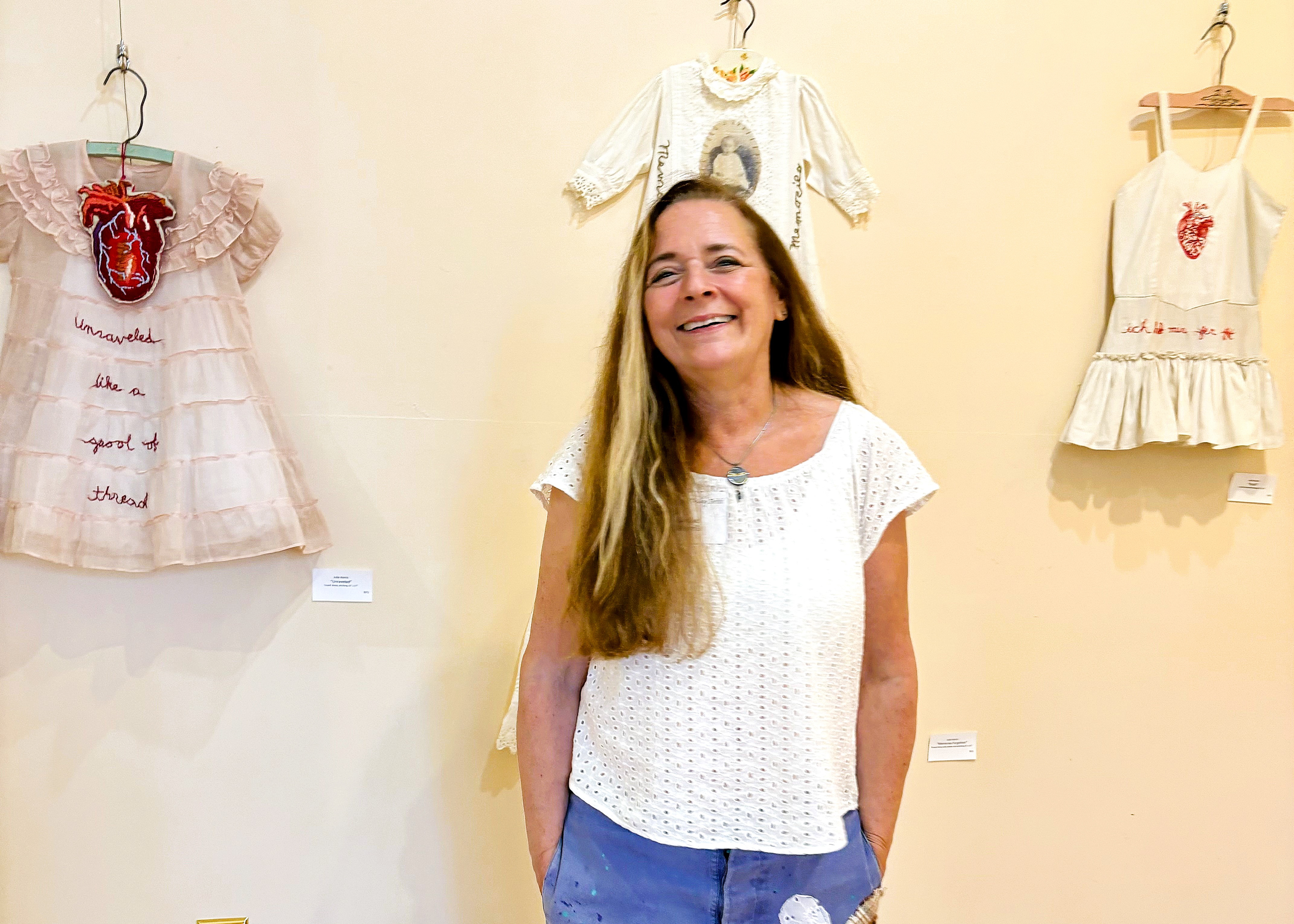
Measured Tenderness traces the quiet space where care and constraint meet. Antique children’s dresses appear as soft architectures, shaped by light, pressure, and time, carrying the memory of bodies no longer present. Once designed to protect, guide, and shape the young body, these garments remain as traces of tenderness and instruction, holding within their seams both intimacy and discipline. In their emptiness, they function as stand-ins for the body itself—structures that once held warmth, movement, and breath, and now hold absence. The dresses are not treated as nostalgic objects, but as forms that register experience. Their ruffles, seams, and fragile cotton surfaces suggest both gentleness and regulation, echoing the ways in which early life is marked by guidance, boundaries, and acts of care that are inseparable from systems of control. As garments meant to shield and shape, they become metaphors for how protection can also prescribe, how safety can coexist with pressure, and how tenderness is often learned alongside restraint. Layered with bones, wings, stitching, and marks of measure, these garments become vessels for tenderness and its limits—records of both protection and regulation. Anatomical forms introduce the internal body beneath the dress, suggesting that what happens on the surface leaves its imprint deeper within. Skeletal references evoke structure and vulnerability at once, reminding us that the body must be both supported and constrained in order to stand. Wings, by contrast, introduce the idea of escape, longing, and movement beyond containment. They gesture toward desire and possibility, toward the impulse to rise above what holds us, even as they remain bound to fragile dress forms that cannot lift from the page. Measurement lines, grids, and seam-like markings suggest attempts to know, correct, and safeguard the body. These marks recall systems of observation: growth charts, medical assessments, posture training, and the many ways bodies are monitored and shaped through institutional and familial care. Measurement becomes both a gesture of concern and a mechanism of control. It reflects a desire to protect by quantifying, to preserve by regulating, to care by shaping what is deemed vulnerable. In this way, the work examines how protection and discipline are often entwined, especially in childhood, where guidance and correction are part of daily life. Stitching enters the images as an act of mending, fastening, and restraint. Sometimes it reads as repair, sometimes as binding, sometimes as closure. Running stitches evoke provisional care—enough to hold something together, but not enough to erase the rupture beneath. They suggest the labor of maintaining bodies and identities within acceptable bounds, and the quiet persistence of efforts to stabilize what feels fragile. The stitch becomes both a mark of attention and a reminder of pressure, a physical trace of care that also constrains. Working through light-based and printmaking processes that register touch and duration, each image holds the residue of contact and absence. SolarFast and other alternative photographic methods depend on exposure, pressure, and time, allowing light itself to inscribe form. The garments must be weighted, held, and stilled in order to record their presence, echoing the ways bodies are positioned, instructed, and contained in order to be seen, understood, or protected. The resulting images are not exact reproductions but translations—soft, imperfect, and shaped by material interaction. This slippage between object and image reinforces the sense that memory and experience are always partial, filtered through time and physical contact. Because these processes record not only form but also the conditions of making, the images retain traces of their own creation: uneven exposure, subtle banding, areas of softness and density. These visual irregularities become part of the conceptual language of the work, suggesting that care is never neutral or seamless, but marked by human presence, error, and variation. What remains is not a perfect record, but a surface that has been pressed upon, altered, and held in place. Rather than telling fixed stories, the work offers a quiet meditation on emotional inheritance—how what once sheltered us continues to shape how we inhabit our own bodies. The dresses carry histories of being worn, washed, mended, and outgrown, but they also carry symbolic weight as forms that once guided posture, movement, and behavior. In this way, they speak to how early experiences of care and correction persist long after the garments themselves have been set aside. The work does not seek to resolve whether these influences are protective or limiting, but instead acknowledges that they are often both. Some images suggest vulnerability without intervention, allowing the dress to appear as a nearly dissolving presence, a body before or beyond regulation. Others introduce marks of control: stitched waists, drawn seams, anatomical overlays that imply inspection or alignment. Still others hover between these states, holding tension between fragility and structure. Together, these variations create a rhythm across the series, moving between tenderness, discipline, disappearance, and repair. The repetition of form allows small shifts in gesture to carry emotional weight, asking the viewer to consider how subtle differences in care can produce lasting effects. Throughout the work, the dress functions as a second skin: a fragile covering, a place of keeping, where the body is guarded and made steady. It becomes both shelter and boundary, offering protection while shaping what it contains. This dual role reflects the complexity of care itself—not as a simple act of kindness, but as a system of practices that mold bodies, behaviors, and identities. The work lingers in this ambiguity, resisting clear moral conclusions in favor of quiet observation. Measured Tenderness does not present trauma as spectacle, nor does it romanticize childhood or memory. Instead, it attends to the ordinary, repetitive acts through which bodies are guided and preserved. By focusing on garments rather than figures, the work sidesteps narrative specificity and instead invites projection, recognition, and reflection. Viewers may read their own histories of being cared for, corrected, held, or shaped into these absent forms, recognizing how deeply such experiences are embedded in physical memory. In this sense, the work is less about individual biography and more about shared human experience. It asks how we learn what it means to be safe, to belong, to be protected—and what we give up, or are asked to surrender, in exchange for that protection. It considers how systems of care, whether familial, medical, educational, or cultural, leave quiet marks that persist long after the original context has faded. These marks may guide, limit, comfort, or constrain, often all at once. Ultimately, Measured Tenderness offers not answers, but a space of contemplation. Through light, fabric, and small acts of intervention, the work invites viewers to sit with the complexity of protection: its necessity, its costs, and its enduring influence. It reflects on how tenderness is shaped by limits, how shelter can become structure, and how what once kept us safe continues to live in the body, quietly shaping how we stand, move, and imagine freedom.