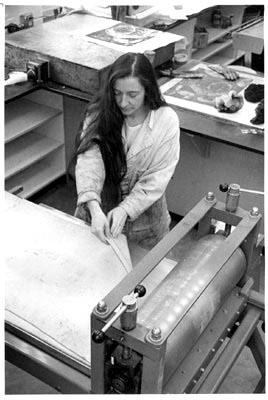
JULIE HARRIS----BIOGRAPHY
Julie Harris is a distinguished American printmaker and educator whose influence resonates not only across the United States but also on the international stage. With a career that spans decades, Harris has established herself as a visionary in the contemporary art world, having participated in more than two hundred regional, national, and international exhibitions. Her dedication to artistic excellence and exploration of deeply personal themes has earned her a respected place within the broader art community.
In 2024, Harris was honored with a prestigious New Jersey State Council on the Arts Fellowship, a testament to her ongoing contributions to the visual arts and her commitment to pushing the boundaries of traditional printmaking. This fellowship recognized her exceptional artistic vision and provided support for the continued development of her creative work. The award served not only as a formal recognition of her past achievements but also as an affirmation of her continuing relevance and innovation in the field.
Currently, Harris serves as the Head of Printmaking at Kean University, located in Union, New Jersey. The university’s close proximity to Manhattan places Harris at the nexus of one of the world’s most dynamic and diverse artistic communities. Her role at Kean University allows her to mentor the next generation of printmakers and artists, sharing her extensive knowledge of technique, theory, and art history. Under her leadership, the printmaking department has flourished, gaining recognition for its rigorous curriculum, experimental approach, and strong emphasis on conceptual development.
Harris’s artistic practice remains centered on the traditional techniques of intaglio printmaking, silkscreen, and handmade paper, all of which are rooted in centuries-old craftsmanship yet open to contemporary reinterpretation. She has also made significant contributions to the field of book arts, an area that combines visual storytelling with sculptural and textual elements. This interdisciplinary focus reflects her belief that art should not be confined to a single medium or mode of expression, but should instead draw from a range of tools and traditions to fully explore the human experience.
A hallmark of Harris’s recent work is her innovative use of found ephemera and antique clothing, materials she employs to construct visual narratives that explore themes of memory, loss, identity, and personal history. These objects—often weathered, fragile, or seemingly mundane—are imbued with layers of meaning through their transformation in her prints and paper works. By repurposing items that were once intimate parts of someone’s life, Harris breathes new life into forgotten fragments of the past, allowing them to tell stories that are both personal and universal.
This deeply introspective aspect of her work represents a kind of visual memoir, where fragments of lace, handwritten notes, aged textiles, and other timeworn items become metaphors for human emotion and memory. In doing so, Harris challenges the viewer to confront their own associations with memory and material culture. Her compositions often evoke a sense of nostalgia, while also questioning the impermanence of life and the fleeting nature of relationships.
Incorporating such tactile and historically loaded materials, Harris’s prints possess a haunting, poetic quality. The layering of textures and the juxtaposition of old and new creates a sense of temporal dissonance—inviting the viewer to step into a space where past and present coexist. These choices also speak to broader themes in contemporary art, such as sustainability, materiality, and the politics of memory. Her work insists that art is not only about aesthetic appeal but also about cultural and emotional resonance.
Her mastery of intaglio, one of the most technically demanding printmaking processes, sets her apart within the contemporary printmaking world. Intaglio involves incising lines into a metal plate, which is then inked and pressed onto paper. The technique requires a high level of precision, patience, and control, all of which are evident in Harris’s finely detailed compositions. Whether she is working with copper or zinc plates, her technical acumen allows her to convey complex imagery with remarkable clarity and depth.
Equally important is her use of silkscreen printing, a method that allows for bold color and intricate layering. Combined with handmade paper—a labor-intensive process that Harris undertakes herself—her works gain a sculptural, dimensional quality. These tactile elements draw the viewer in, inviting close inspection and prolonged engagement. The process of making handmade paper adds another layer of meaning, symbolizing a return to slow, deliberate craftsmanship in an age of mass production and digital reproducibility.
In addition to her studio work and teaching, Harris has participated in numerous artist residencies, lectures, and workshops throughout her career. These engagements have taken her across the globe and provided her with opportunities to both share her expertise and draw inspiration from other cultures and artistic traditions. Whether working in Europe, Asia, or the Americas, Harris maintains a consistent focus on connecting the personal with the collective, the tactile with the emotional.
Her contributions to the book arts further demonstrate her versatility as an artist. By creating limited edition artist books that combine image, text, and structure, Harris explores the relationship between narrative and form. These books often serve as intimate reflections on specific themes, such as grief, motherhood, or the passage of time. In these works, she often blends personal narrative with broader social commentary, challenging traditional ideas about what constitutes a “book” and how it should be read or experienced.
Harris’s work is represented in numerous public and private collections, including university archives, museum holdings, and corporate collections. These institutional acquisitions underscore the significance of her work in the wider context of American art. Her contributions have been recognized not only through exhibitions and awards but also through scholarly articles, catalog essays, and interviews that analyze her impact on contemporary printmaking and visual storytelling.
Despite her many accomplishments, Harris remains deeply committed to her artistic journey, viewing each new piece as an opportunity for reflection and growth. Her work continues to evolve, responding to changes in the world around her while staying rooted in the tactile, handmade processes that define her practice. For Harris, the act of creating art is both personal and political, an exploration of how the past informs the present, and how the ephemeral can be made enduring through the act of making.
In summary, Julie Harris is a master printmaker whose career has been marked by innovation, dedication, and profound emotional insight. Her work transcends traditional boundaries between craft and fine art, blending materials, techniques, and themes in ways that are uniquely her own. Whether through her role as an educator, her involvement in the art community, or her evocative studio practice, Harris continues to make a lasting impact on the field of contemporary printmaking.